

Morning, friends! ☀️
Sometimes you meet the most amazing people doing the most amazing things, taking on challenges I’d never even imagine.
That’s what impresses me again and again about the people I’ve met through writing this newsletter, people who aren’t thrown by what might seem impossible to many of us.
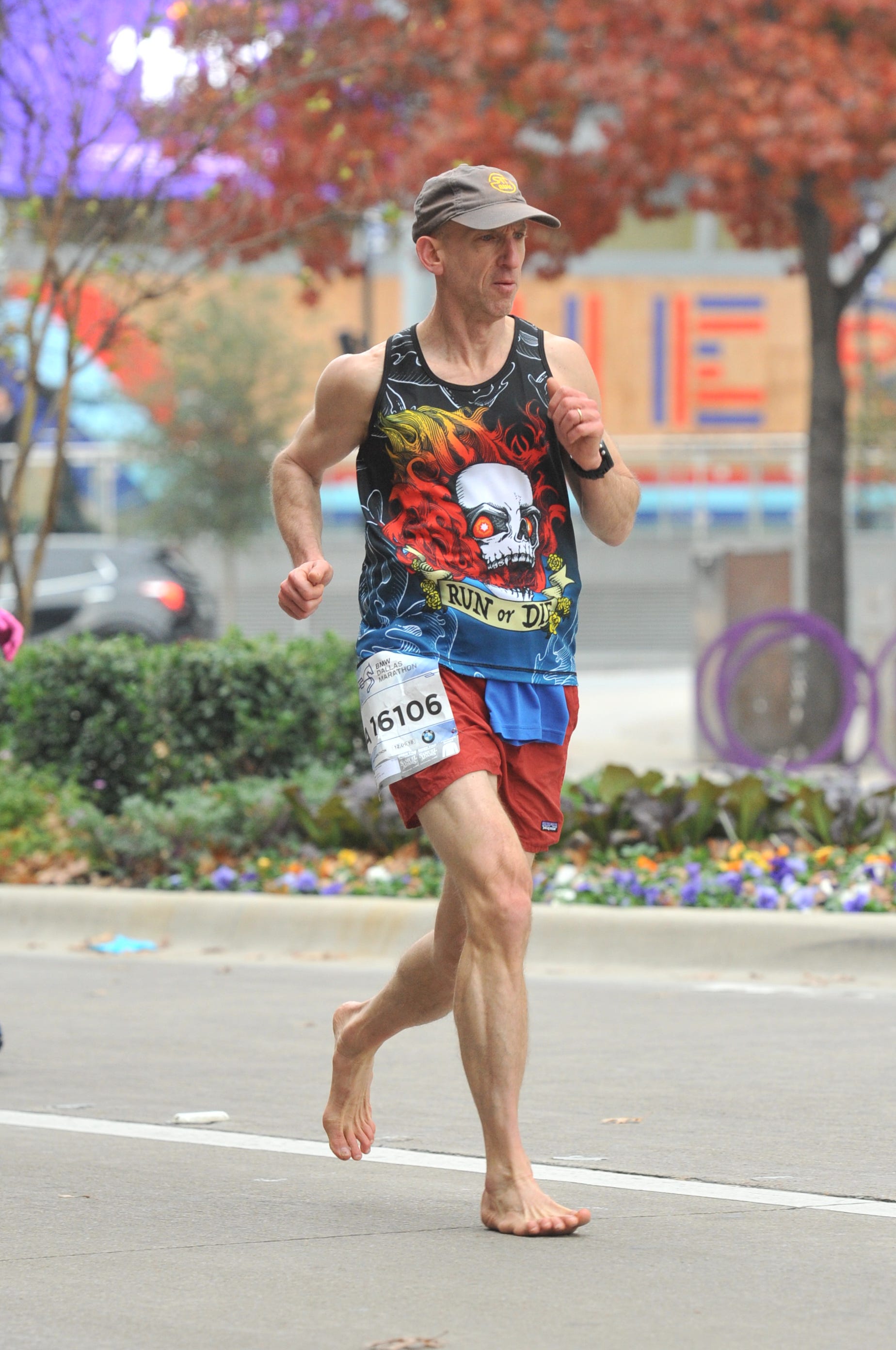
And that’s definitely the case with today’s interview, a man from New York named Kenneth Posner, who since he took up running has completed more than 100 marathons and ultra-marathons — and more than two dozen of those, he ran barefoot!
You’ll understand why when you read Ken’s interview, so why don’t I put down the mic and let Ken take his turn — I know you’ll love and be as awed by his story as I was. And, as always, if you’d like to share your story, I’d love to hear it!
Keep in touch and let me know how your running/life is going. — Terrell

So, let’s hear a little bit about you! Who are you, your age (if you’d like to share), where you’re from, what you do, etc.
I’m a runner, writer and analyst. Aged 63, I live in New York’s Hudson Valley, and work as a consultant advising companies on strategy and investor relations.
What does your running routine look like? How many times a week, and how far do you run?
Every week is different because my goals are constantly changing, and I'm always super-focused on how I'm feeling, rather than trying to follow a rigid plan.
I love track sessions, where I practice what I call “controlled intensity interval training." This could be 1/4's or Yasso splits or a mix of things, but as the title implies, with an intense focus on control.
I believe that control is one of the most important attributes in life — and if you don't believe me, ask a race car driver or a fighter pilot! For runners, the reality is, as we get older, injury risk and recovery time increase, meaning we have less room for error, and precision becomes more important.
I've built some controls into my training log to track injuries and irritation, which helps me confront the reality when things aren't going well. Having said that, I still feel a need....for speed! Why, I love running hard and fast and I crave the intensity.
As we get old, we don't want to get too cautious. We don't want to give up. I like to borrow a phrase from our Army friends — "stay in the fight." This means still practicing "grit," which is another way of saying, still taking on some level of risk, because without taking risk, you can't learn.
For easy runs, I love to visit the local grasslands, where the trail is soft and grassy, sometimes sloppy mud and puddles after rain, or sometimes hard-baked in the dog days of late summer.
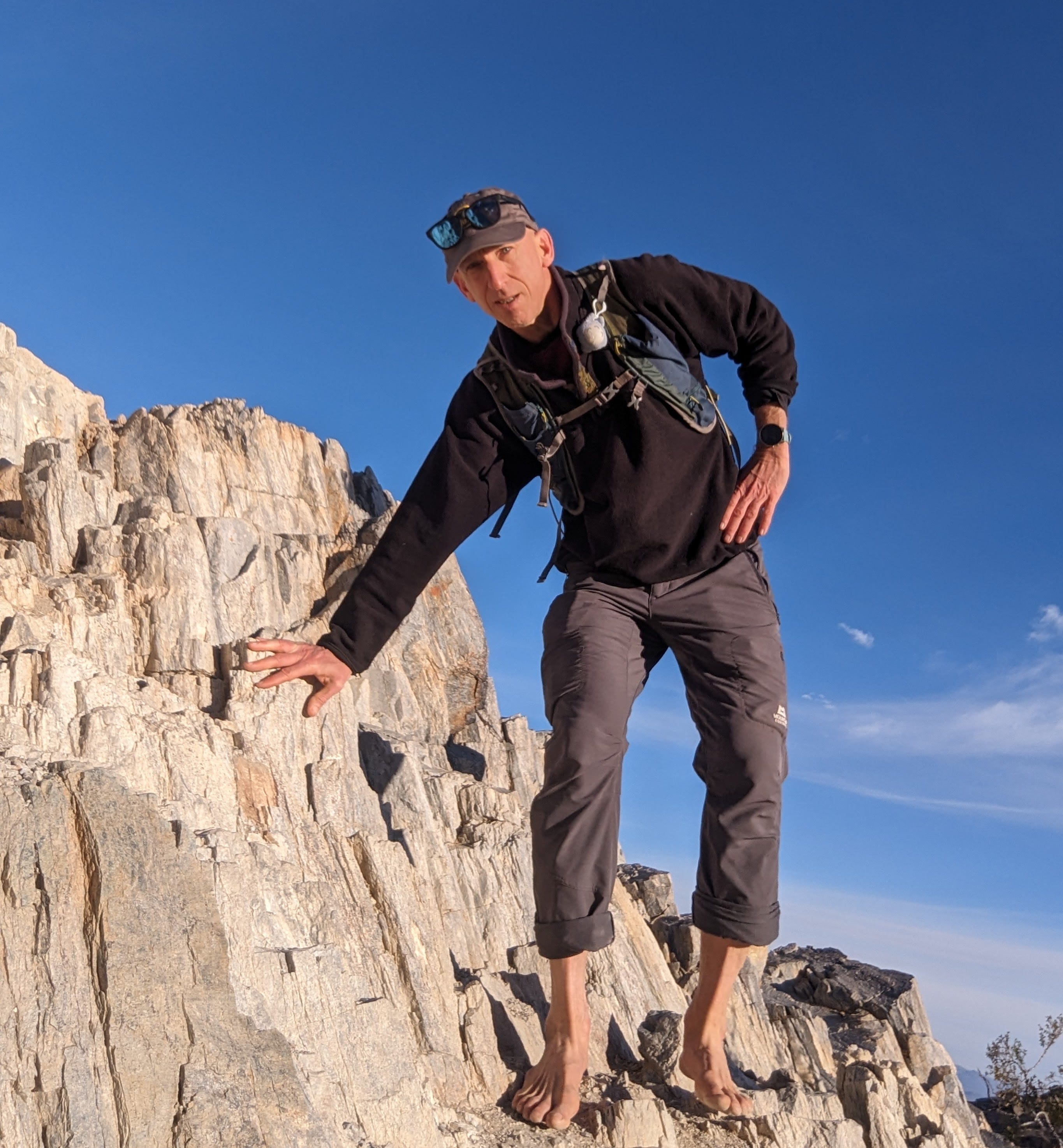
There are a couple sections with some gravelly rocks, which forces me to pay attention as a barefoot runner. These grasslands have amazing wildflowers — wave upon wave of color changing from spring to fall — butterflies and birds galore — a herd of deer which always see me first unless I turn a corner when the grass is high and surprise one from behind — and coyotes which never come out during the day, but you see their scat.
Racing is a big focus for me. I love every distance from 5K to ultra. Tomorrow is a half marathon on a smooth flat course, and I'm really excited to get out there and try.
Were you an athletic kid growing up? What are your early memories of what fitness and health were about?
Growing up, I was an athletic disaster. I still remember how a kindergarten friend once pushed me and I was so upset, I couldn't move.
By age seven, my baseball dreams were over, as I discovered that baseballs are actually quite hard, and if you close your eyes they're difficult to catch (I learned to keep my eyes open when I was about 40). I hated gym class. I was literally the last one picked for every game.
By the time high school rolled along, I was starting to try a little harder, thanks to some encouragement from the coach. Outside of school, I had fun with karate and fencing.
As for running, however, I suffered from debilitating shin splints — later diagnosed as chronic anterior compartment syndrome — which caused my shins to swell and go numb after about 10 minutes, although weirdly, if I persisted and clumped along for 45 minutes or so, the condition would begin to fade.
It was so frustating! My career as a runner started with endless frustration. Eventually I had surgery to alleviate the condition.
How did you first get into running? Was there something that inspired you — like a performance at the Olympics, for example, or a runner you discovered by watching them on social media or TV? Or was there someone in your own life who inspired you to think, ‘maybe I can do this?’
In high school, my fencing coach had me do some running to build stamina, but due to the compartment syndrome I never ran more than a mile. After college, somehow I made it through four years in the Army, where better overall fitness helped me manage the shin splints most of the time.
The Army is where I first discovered the importance of physical and mental endurance... and the deep sense of satisfaction that comes from a hard day's work with both body and mind.
I started to get more serious about running in my thirties, after surgery for the shin splints, although now my problem was Iliotibial Band (ITB) syndrome, which, strangely, no one seemed able to diagnose.
During this period, I was working on Wall Street and saw colleagues getting sick and falling by the wayside. In fact, there was a boss who had a mild heart attack and retired early, which led to me getting a promotion. And then a colleague who smoked and drank and disappeared on a medical leave, which led to another promotion as I was assigned her workload.
I decided that if I was going to last, I had better invest in myself. About that time, a memory from my teenage days resurfaced about a man who'd celebrated his 40th birthday by going for a 40-mile run.
With my 40th birthday looming, I suddenly realized that I would have to do something like that, but long distance running was so painful and boring it actually took me until age 42 to get it done, which is when I discovered ultra-running.
How has your interest in running evolved since then? Do you run farther, or faster now?
The initial hook into ultra-running was the chance to travel to beautiful places (my first 50K was on Angel Island, in the San Francisco harbor).
Very quickly, ultra-running became a huge passion. The sport nearly took over my life. It was a good fit for me, since it didn’t require any special coordination or skill, which had never been a strength of mine, and thanks to the shin splints and military experience, I’d gotten used to persevering in the face of difficulty.
It was SO THRILLING to discover that I could reach the finish line for longer distances than I’d ever imagined possible. With training and racing, I got faster, eventually setting all my PRs in my early fifties at distances from one mile (faster even than I’d run in college) to 100 miles.
I also set a handful of multi-day fastest known times (FKTs), including for the 350-mile Long Path in New York State and the 294-mile Badwater Double, which stretches from Badwater Basin in Death Valley to the summit of Mount Whitney and back.
I like to describe running as the ultimate source of self-empowerment, because with each race you prove you can manage yourself in a high-intensity, high-stress regime. The rest of the world may be totally outside of our control, but at least you can control yourself.
By my mid-fifties, however, I began to face a new set of injuries, partly related to the inevitable aging process, but also partly related to bad form that I believe I developed from running in shoes.
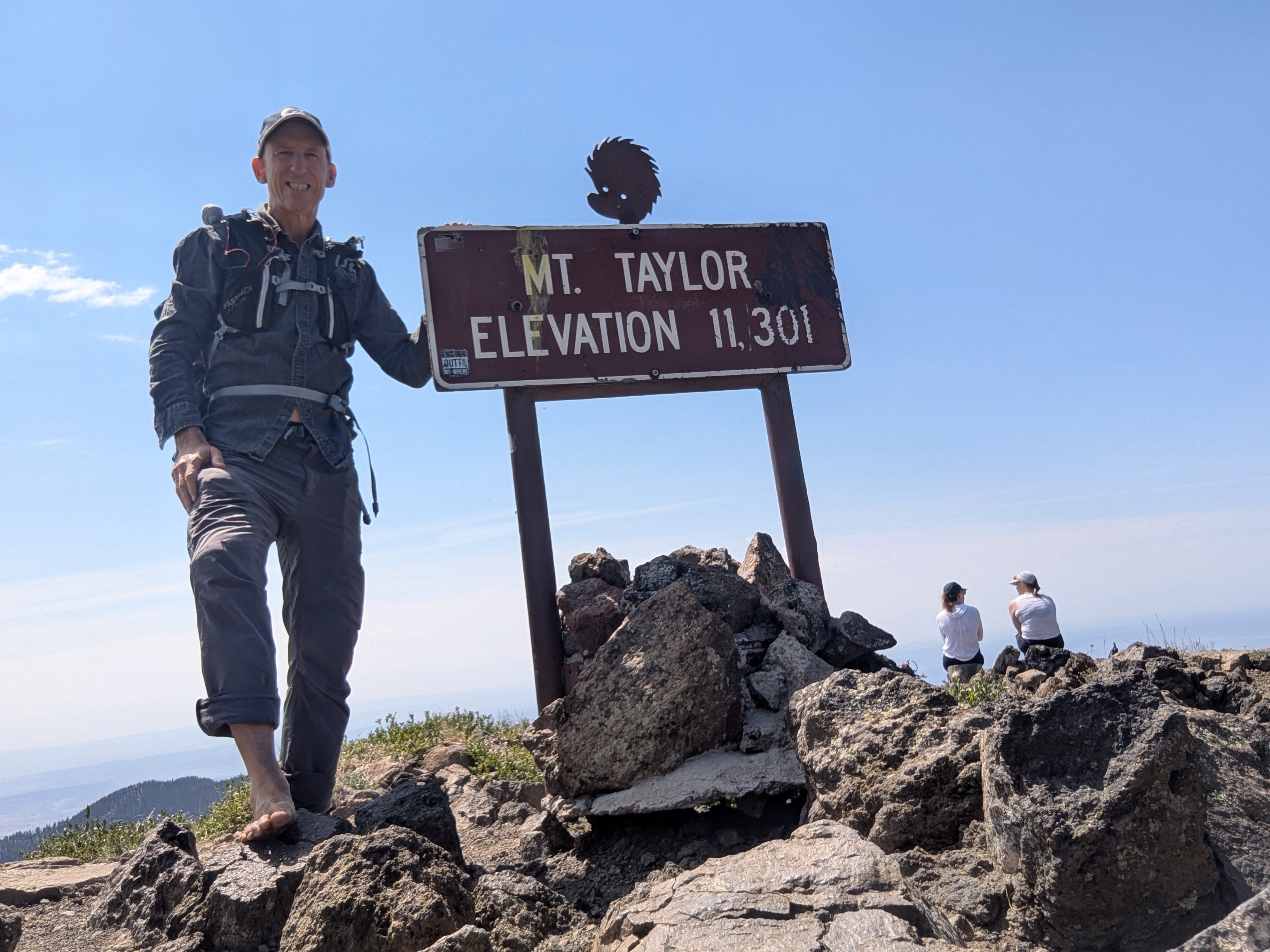
The worst was posterior tibialis tendinitis, which dogged me for two full years and ended the aggressive phase of my ultra-running career. I was forced to pivot, shifting to a lot more hiking and taking on different kinds of challenges like a peak-bagging project called the “Grid,” which is the subject of my book Chasing The Grid.
The Grid is a big project, entailing 420 separate climbs. But there’s no rush. You can take multiple years to get them done. The Grid is more like a pilgrimage, rather than a race.
During this period, I was spending a lot of time in the mountains and I began to change. I started running and hiking barefoot. I experimented with fasting. I got into cold training (running shirtless in the winter), moving at night without lights, natural navigation (off-trail without map/compass or GPS).
Overall, I tend to think of this new style as “super-minimalist” or as “running naturally,” the way our ancestors used to, instead of the more conventional running we practice today, especially the new super-shoes, [and the] preoccupation with complicated metrics like VO2 max and HRV, and now the 120g/hour carb-fueling. Increasingly this looks like tech-enabled running.
What do you balance your running with? Do you have a family to take care of? Kids, parents or other relatives or loved ones? If so, how do you balance all of it and still make time to run/care for yourself?
I like to joke that my biggest challenge today is balancing running and hiking! All kidding aside, I don’t really use the idea of “balance” in my life. I consider myself aggressive and action-oriented.
I’ve done some things, and I want to do more. That means embracing an execution mindset, which includes detailed planning, ruthlessly cutting out the non-essential, and accepting some risk of conflict and chaos.
Now, it’s easier for me today because I’m single and an empty nester, which allows me to live a very frugal and simple life with minimal distractions.
Having said that, family occasions are still the top of my priority list, and if one of my kids calls, I slam the brakes and pull over to talk and everything else goes on hold.
I’m getting close to retirement, but still looking for ways to make a difference in the corporate sector, which at this point is a lot of fun for me, since I’m really good at my specialty.
I love my community and am constantly looking for ways to give back, which I do in part as board chair for two organizations, the New York-New Jersey Trail Conference and Run Wild, Inc. Given my love for getting outdoors, land conservation is very exciting for me, as is the chance to create opportunities for kids to experience nature.
To be honest, one of the keys to my current “success” is the decision I made a few years ago, to stick with my current corporate specialty, rather than stepping up to a bigger leadership role. Maybe this is a limitation, but if I don’t get enough running and time outdoors, I pretty quickly start to feel unhappy.
Is there anything you’re especially proud of that you can point to your running and say, ‘this helped me achieve ______’?
I’m proud of every race I’ve finished and every mountain I’ve climbed — although to be sure, some are more memorable than others. “Proud” not in the sense of being arrogant, but that deep sense of satisfaction that comes from having gone out there and done something.
By the way, I love my finishers’ awards because they remind me of what I did — I have boxes of the trinkets!
Does running help me achieve things? For sure. Running is a practice which in my opinion generates the full mind-body engagement that is our birthright as human beings. Running taps into the deep wells of strength and energy that all people have — the strength and energy our ancestors needed to survive living naked in the forests.
My sense is that in the modern world, with so much emphasis on comfort and convenience, there’s a risk of settling for less intensity, which means less engagement and less independence.
For me, the most powerful aspect of running is the sense of self-empowerment which spreads throughout life. This — not how you feel right after a race — is the real “runner’s high.” For me, running provides the energy that powers the rest of my life and it is also key to the positivity that I bring to my relationships with other people.
What have you learned about yourself from your running journey? Is there anything that’s changed about you since you started?
For me, running has also turned into a gateway to the inner world of subjectivity and spirit. I believe this inner world is super important because it contains the genetic wisdom accumulated over billions of years of evolution, what Carl Jung called the "collective unconscious."
This inner world contains our sense of intuition and judgment, our connection to nature, and the true magic of life.
I am very curious about indigenous culture, as a window into how people thought before the introduction of modern industrial technology — for example, the Lipan Apache concept of "good medicine," which refers to special experiences in nature, and how they can spread a glow throughout your life and change your thinking.
In this regards, I think of running and hiking outdoors in part as a practice of vision-questing, and really as the spiritual foundation for my life.
Where would you like to go with your running? Is there anything special you’d like to achieve — like, say, running all six World Marathon Majors, or running an ultra?
In my forties and fifties, it was all about those A races, like Leadville, Badwater, Boston, New York, etc., and then the FKTs. In other words, my goal was to break through perceived limits and discover what I could truly do.
Now that I'm in my sixties, my goal is to sustain the practice. Instead of individual events, today I'm more focused on multi-year initiatives. For example, I've run 117 marathons and ultra's (29 of which were barefoot), and I'd like to keep growing this count.
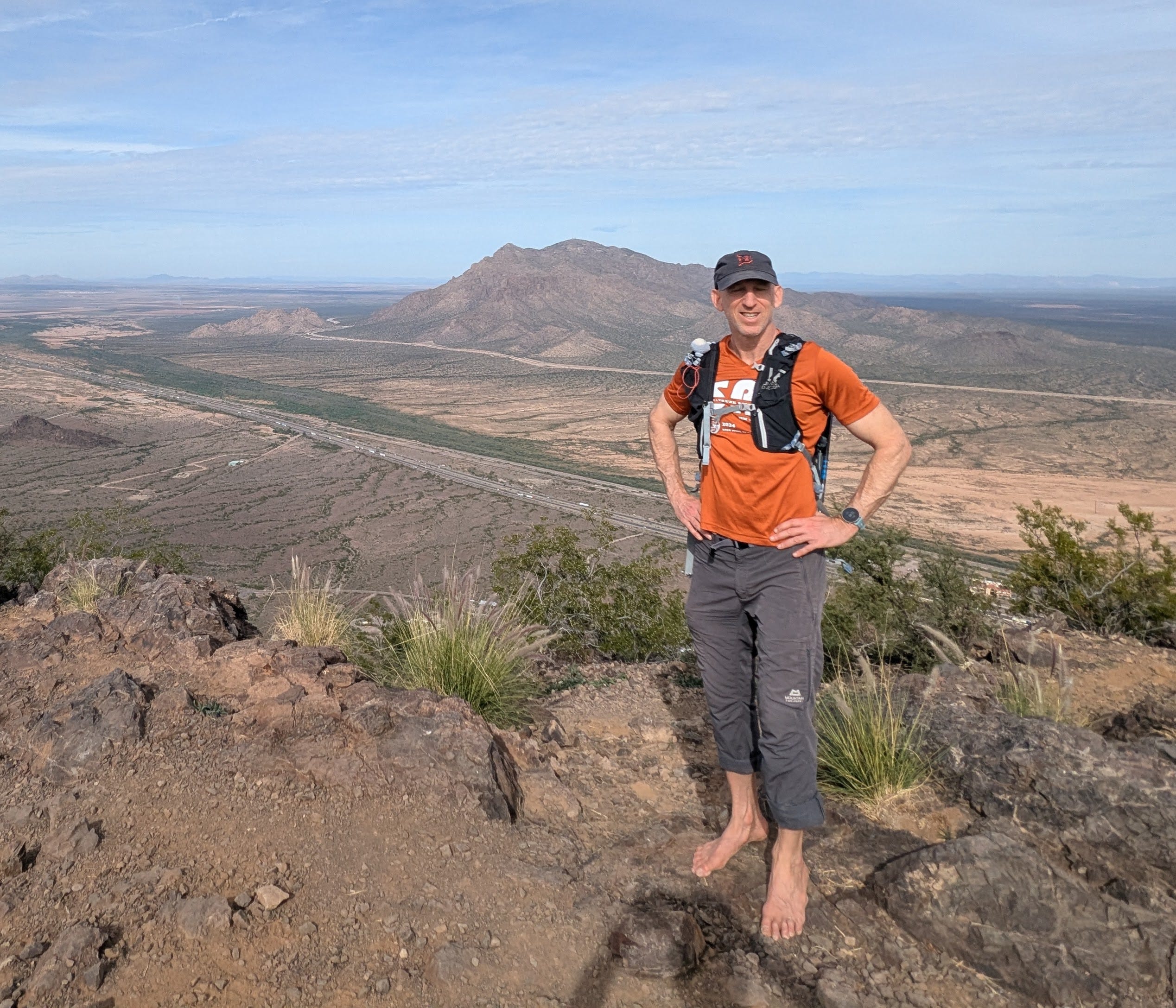
I've climbed 647 mountains barefoot, towards a multi-year goal of 1,000, and I'm constantly thinking about the next set of peaks to go after. I celebrate every 1,000 miles of barefoot training (running/hiking/walking) and want to keep growing that number.
For this year, goals include taking another shot at some of my barefoot PRs (I set a new 10k barefoot PR last year and a 5k PR the year before), as well as getting back to 100 miles in 24 hours (or closer, anyhow).
What keeps you going? Especially if you’ve been running for a while — do you ever get bored with it? How do you find new things to motivate you, to keep you going?
Goals keep me moving. Goals generate energy. The positive outcome from achieving a goal times the probability of success = the energy budget available to pursue it. Set the right goals and you can live a life of virtually unlimited energy. I come up with new goals all the time, mainly by letting my imagination run.
Boredom isn’t typically a problem for me. If you think about “flow state,” recall the “flow channel” as defined by Mihaly Csikzentmihalyi, the psychologist who coined the term, is bounded by anxiety on one end, and boredom on the other. Anxiety is when intensity is too high for us to manage, boredom is when intensity is too low.
One way to deal with boredom is to work on structuring your thought processes, for example, by taking the dreaded treadmill workout and adding micro-intervals where you are constantly varying speed and inclination or by breaking the session down into smaller parts (yay, I just got to 10%...yay, I just got to 20%...etc).
Having said that, okay, I admit it — treadmill runs are sort of boring.
Look back at yourself when you were a kid, maybe say 10 years old. Remember how you felt, what you thought, especially what you thought you were capable of back then. If you could talk to that kid now, what would you say?
What I generally tell young people is, go for it. Action produces outcomes, so whatever happens, you are guaranteed to learn and grow.
As you get older, you develop greater capacity for patience (old people are crafty) — but this is rarely the right course for young people, who are charging forward into the unknown.
Explore more from THM
There are so many more reader stories we’ve shared — don’t miss these:


Ken, as I began reading your "story" I was initially struck by how much you reminded me of my favorite running book, "Running & Being" by Sheehan. I immediately thought that you should write a book and lo and behold the next paragraph revealed that you did. I will order it today given that so much of your "story" resonates with me on a deep, soulful level. Almost 80, I have been looking for a fellow runner to get me going again. My intrinsic motivation has been AWOL & I look forward to the arrival of your book. Energized to see a runner who has put some much thought into his passion and deeply understands the "necessity" of challenging oneself in a world that has us "hooked" on convenience. Running may not be a panacea but it as close to one that I have ever found.
Thanks Terrell for introducing Ken to your readers.
Ken, your intrinsic motivation is palpable and pervades everything you do - whether work or "play". I love your simple statement "action produces outcomes". That doesn't mean they should be random acts but "wanting" or "hoping" to do doesn't make it happen.