

Evening, friends! 🌜
Above all, the best thing about writing this newsletter is hearing from readers just like you, as I love hearing your stories and about where you are in your journey — whether that’s running or your life.
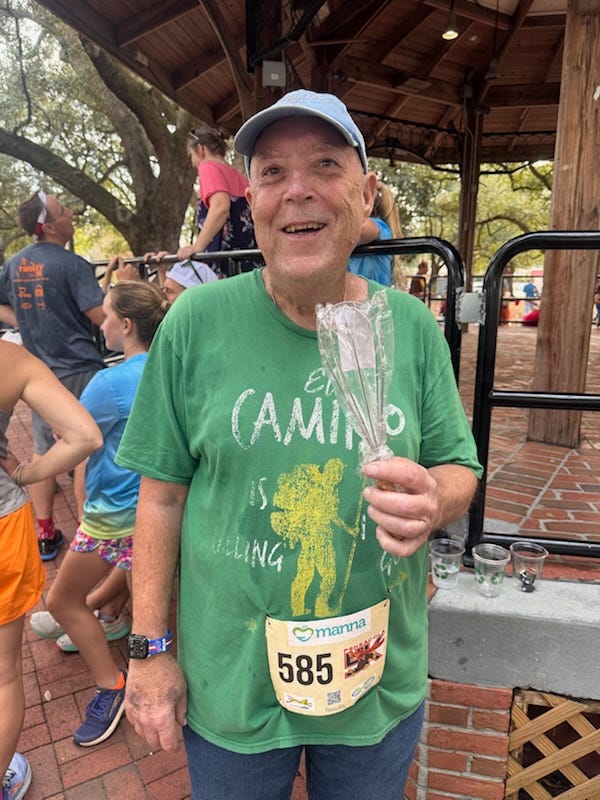
I couldn’t have asked to hear from a sweeter, more heartwarming man than Jim Newton, who wrote to me last week when I asked readers to share their stories with us.
I don’t think I’m going out on a limb to say you’ll be as touched and moved by Jim’s story as I was, and to just imagine what he’s gone through in his life — from going through cancer treatment twice to all the places he’s been through running, both in this world and in his spirit.
That’s enough of me yammering on, though — I’ll let you enjoy Jim’s story. But also, please know I’d LOVE to hear your story too, if you’re interested in sharing it. All you need to is reply back by email or in the comments below, and we’ll go from there. — Terrell
So, let’s hear a little bit about you! Who are you, your age (if you’d like to share), where you’re from, what you do, etc.
I was born in Elmira, N.Y. on October 12, 1949. An interesting fact is that when Columbus Day was celebrated on its actual day, I never had to go to school. I was an environmental engineer for over 46 years and am now retired.
I still am active as an engineer by conducting webinars for professional engineers on various topics. I offer over 50 webinar topics. I am trying to become a produced scriptwriter and have written many scripts, several of them have placed in writing contests.
I have used my running experiences in many of them. I started running at the age of 28 trying to lose weight. I have now been running for over 49 years and have covered over an estimated 60,000 miles. I have completed 17 marathons, the first in 1978 and most after I turned 55 (15).
In 2014, I was diagnosed with Stage IV mantle cell lymphoma (MCL), an aggressive blood cancer. I have been in remission since 2015 and continued treatment through 2017. I ran several half marathons while undergoing treatment. In 2021, I was diagnosed with acute lymphoblastic leukemia (ALL) and in 2022 received a stem cell transplant and am now in remission. It is ironic that I used to run marathons for Team in Training, a fundraising arm of the Leukemia and Lymphoma Society.
I am also dealing with squamous cell carcinoma, a result of my many years of outdoor running. I refuse to run on a treadmill; [I’m] always afraid I’d fall off (I used that in one of my comedies). I also sing in various church choirs and have done so for over 35 years and occasionally cantor at mass.
What does your running routine look like? How many times a week, and how far do you run?
I typically go out running around 8 each morning. I cover 3-4 miles a day, six days a week. If I’m training for a half or 10K I will go longer. I actually ran several half marathons while going through my cancer treatment. In ended up in the ER a couple of times for dehydration.
While being treated for ALL at the M.D. Anderson Cancer Center in Houston, I was hospitalized for 30 days. I would walk around the nurses’ station three times a day, 10 laps dragging my IV pole I called George.
George and I walked 3 miles each day. He sometimes protested but I pulled him along. George and I also walked 300 days after my stem cell transplant. In between I had to have an infusion pump and walked the Houston neighborhood. I referred to them using female variations of George (Georgette, Georgia, etc)
Were you an athletic kid growing up? What are your early memories of what fitness and health were about?
I was not an athletic child. I wore husky clothes. I once tried out for my high school basketball team. I had never actually played and pulled a muscle in my first practice. I never even considered track and field.
How did you first get into running? Was there something that inspired you — like a performance at the Olympics, for example, or a runner you discovered by watching them on social media or TV? Or was there someone in your own life who inspired you to think, ‘maybe I can do this?’
As I said, I started running to lose weight. I went from 197 to 140 over the first year of running. I targeted the 1977 Peachtree Road Race. At that time, total entrants were 11,000, a far cry from now. I ran the Peachtree for 15 straight years, now I run the virtual Peachtree.
I had a coworker who would play golf after work. We rode together, so I started running around the golf courses while he played.
After completing my first Peachtree, I thought a marathon would be cool. I was never thought of as athletic and wanted to show me and all my old friends that there were some athletic genes in me.
How has your interest in running evolved since then? Do you run farther, or faster now?
At 76, I am much slower. I ran my fastest marathon in 1980 and completed it in 3:52. I stopped running marathons while undergoing chemotherapy. I intend to return to them soon.
My ultimate goal is to be the oldest US male to finish a marathon. When I run now, I am around 15-16 minutes per mile. I often hear people complement me on my walking pace, although to me it feels more like running/jogging.
I also use the time to pray the rosary, and ruminate on my various stories.
What do you balance your running with? Do you have a family to take care of? Kids, parents or other relatives or loved ones? If so, how do you balance all of it and still make time to run/care for yourself?
I am retired now so most of my time is spent running, reading or writing and going with my wife and kids. I have four adult kids, two boys and twin girls. One of my daughters has three kids. All but one of my kids live within four miles of us.
Is there anything you’re especially proud of that you can point to your running and say, ‘this helped me achieve ______’?
I have completed 17 marathons. Each one has a different story. I ran NYC twice. I ran the NH marathon in a driving rainstorm and developed a blood blister on my ankle. I ran the Rehoboth marathon in 17°F windchills.
I ran the Marshall University marathon and was beaten by a 91-year-old — but was ok with it since he set the US record for 90+ in that race. I ran the Monster Marathon and finished last in 7 hours, but took second in my age group.
The USA Track and Field Association offers an award for runners over 40 called the Pheidippides Award. Runners meeting specific point totas based on the type of races completed, receive a plaque. I have been awarded 10 years of these awards — the tenth is a crystal plate.
What have you learned about yourself from your running journey? Is there anything that’s changed about you since you started?
I have learned that I can do whatever I put my mind to. It just takes perseverance and dedication. Also, as I get older I have a better chance of winning medals since there are so few runners in my age group!
Where would you like to go with your running? Is there anything special you’d like to achieve — like, say, running all six World Marathon Majors, or running an ultra?
I want to get back to running marathons and be the oldest U.S. male to complete one.
What keeps you going? Especially if you’ve been running for a while — do you ever get bored with it? How do you find new things to motivate you, to keep you going?
I am now targeting 50 years of running and maybe 75 years because 50 years is next year. Running is part of my daily routine, and I feel lost when I don’t, although it is not as strong a feeling now. Running offers me the opportunity to pray each day and helps me with my writing, especially when I have a project I am working on.
Look back at yourself when you were a kid, maybe say 10 years old. Remember how you felt, what you thought, especially what you thought you were capable of back then. If you could talk to that kid now, what would you say?
I would likely tell him to open up and be more outgoing. I was always a shy kid and kept to myself. Sometimes it was the result of being bullied. I would have liked to have taken chorus or acted in a musical.
Explore more from THM
There are so many more reader stories we’ve shared — don’t miss these:


Nice to meet you Jim. I’m from Ithaca so I know Elmira quite well. Did you ever run the wineglass in Corning? Keep moving if you could put what that does for us in a pill everyone would take it. Also your attitude is a superpower
Wow - you are amazing!
I'm about to turn 60 and I have a goal of being a fast old lady :). You give me hope.
also - good to know I'm not the only one afraid I'll fall off the treadmill!