


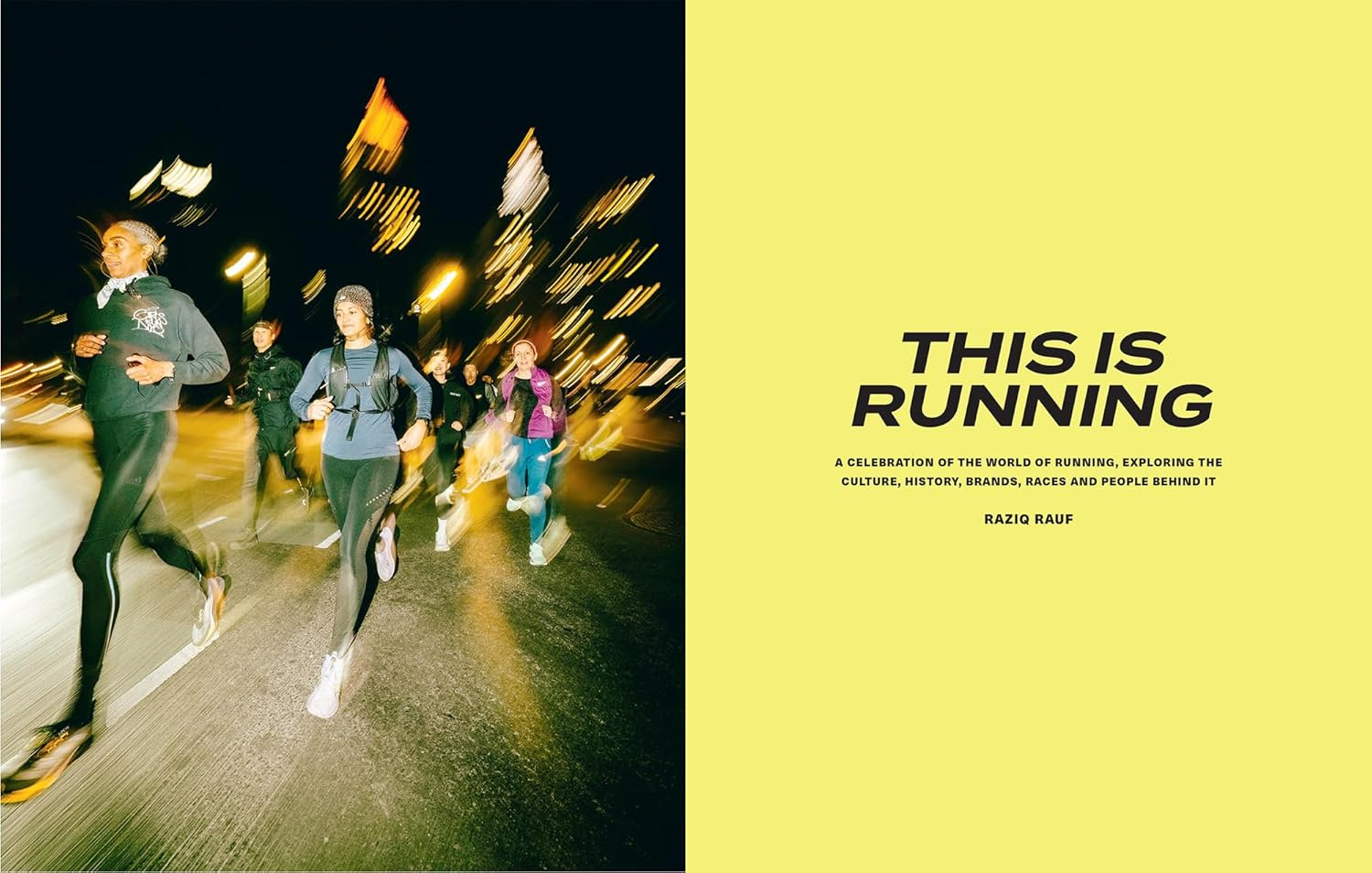
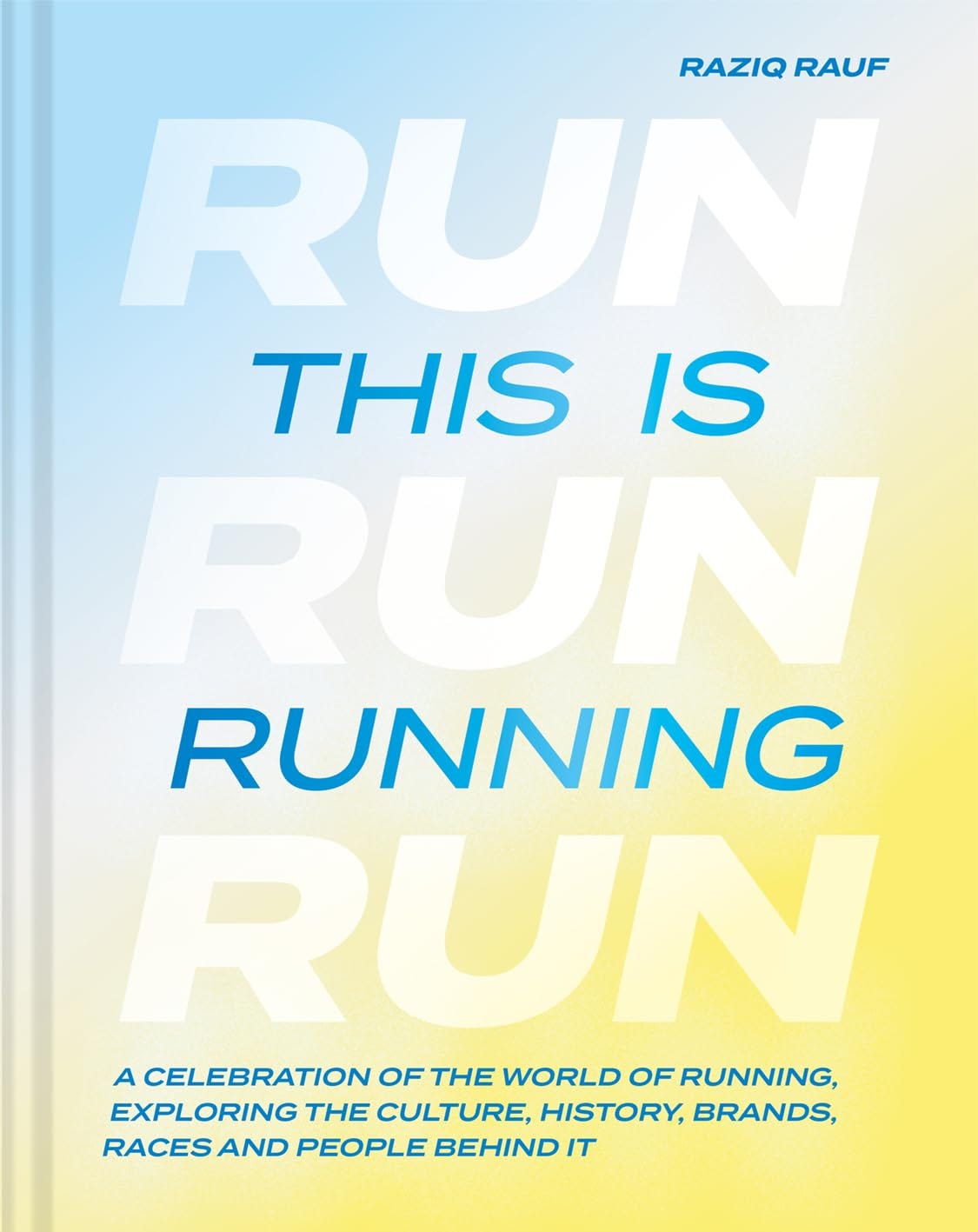
A quick intro: Raziq Rauf, who writes the fantastic newsletter Running Sucks and whom you may remember shared his story with us back in October, has written a brand-new book titled This Is Running that I’ve just read and absolutely loved. Raziq joined me for a conversation earlier this week about the book, what’s special about the sport we love, and how it’s opening up to more people than ever before. I hope you love it too!

Terrell: I had the chance to read it over the weekend, and it’s this really is running — it really covers the entirety of the sport. But let me just ask, first of all, just tell everybody just about a little bit about who you are, you know, how you come to us and what inspired you to write the book?
Raziq: I’ve been a journalist for 25 years now, and I’ve been running for longer than that, so it feels like the it feel just just from that line, it feels like the natural thing to do. I was born in London, [and] I was a music journalist in my twenties, and I moved here to Los Angeles. I live in L.A. now.
I did a bunch of standard corporate jobs in America — still centered around writing and content and stuff like that, it wasn’t too far away from my training, but I wasn’t quite getting the fulfillment that I had as a music journalist.
So at the start of 2023, I thought I’d start a newsletter, and I was thinking, “what can I do?” Because I didn’t want to go back to being a music journalist. I still want to write about something I really care about, and it’s running. Running has been the only other ever-present in my life.
So I started that, and I called it Running Sucks, because that is a foundational principle of mine. I trained as I trained as a USATF running coach about eight years ago, and one of my foundational principles is that it’s really difficult.
My focus is on new runners, and how and helping new runners become regular runners, how can I get somebody to become a lifelong runner? And one of those things is finding the thing that’s difficult, because there’s always something that’s difficult, and helping them solve that.
And so I called it Running Sucks. Some people don’t get the joke, or don’t agree. I know you do, and that I found that interesting because, you know, I understand it’s a somewhat abrasive title, because we love running. I wouldn’t be spending so much of my time writing about running if I genuinely thought that running sucks!
I found out so many different ways of thinking about running, how people think about running over the past three years. I started the process for this book about 18 months ago, actually, and it’s almost, it’s almost here, unleashed on the public.
What was the kernel [of] the book, the idea that inspired it? What was amazing to me is, like, I feel like there were little pieces and parts of this I knew just from my experience running my own newsletter over all these years, and certainly had picked up over the years. But I don’t know that I’ve ever really assembled it all into a cohesive whole in the way that you do in this book — this really is the world of running.
I’ve come to understand that I follow the Socratic method when I’m writing: very inquisitive, very curious, [and] I have a deep desire to know everything. Which is impossible! But through that desire, I do get at that big picture thinking.
So I think about every facet of running, and I’ve tried to, I’ve tried to include every facet of running [in the book]. I’ve tried to be comprehensive so that everybody can find something in this book — whether they are just running 5K every day out of habit, or if they are training for half marathon every year, or trying to complete the marathon majors, or running an ultra, they will find something in this book.
And I like to overthink (just like Socrates was accused of). But his method, his method spoke to me, speaks to me. And so, yeah, I’m glad you think it’s thorough, because my goal is for it to be thorough.
One of my favorite stories in your book is about Josh Clark, who invented the Couch to 5K app — I always assumed it was Jeff Galloway, or another famous runner. But it was not, it was ‘just some guy.’ So can you tell a little bit about that story?
Yeah, he’s a tech guy. I was talking to him, and he was, he was explaining his thought process. That’s one of the things I love about talking to people, I get to find out how they tick. I always talk to people who have created something great, in my opinion, and I want to find out how and why they’ve done it.
He thinks about the world in terms of strategic frameworks; he’s very, very straightforward, technical, analytical. And so he wanted to get back into running. And he asked himself, how do I provide a framework for myself?
We all know that these couch-to-5K plans have always existed in some shape or another. Google them, and you can find a thousand of them.
But he made a destination for it. And he just made a really simple framework, which was really easy, pleasant to follow through with, and achievable. And he just struck gold… that didn’t make him a millionaire or anything, but it’s a legacy. Everybody knows that name.
If you’re running, and you come across it, you know, your first thought is going to be, well, how in the hell do I do this? It looks so hard. And then you hear that name, “Couch to 5K” and it’s a great entry point into running for someone who’s never done it before.
It’s so simple. It’s so genius. And correct me if I’m wrong, but he also, like, created sort of this community around the app and the route for people who are doing this, and for for new runners, and for people continue to do it.
This was back in the olden days of of the internet, when there were message boards independent message boards per website, [when that’s what] built community. And they built, you know, one for beginners and one for one for more advanced runners… I used my journalistic tendencies to hunt him down, basically. And I was lucky enough that he was happy to hear from me, and he responded. He’s a great guy.
Something else that sticks out in my mind is running culture and running apparel, [which] is a big interest of yours. Obviously, there’s been running apparel for a long time, [but] before it was just Nike and Brooks and they were all very similar, I really couldn’t tell them apart. Now each brand has its own signature look.
It’s really only been over the past 10 years that this new wave of brands has come through, making apparel that is distinctive and fashionable, you know, something that you could literally wear your personality on your sleeve and chest and shorts.
You know, before it was just the big shoe brands. You got your Nike, you got your Adidas, Puma, Brooks, that you just pick up a t shirt from your local running store and say, this will do.
But now you have all these brands, [which] have personality running through them — they have a distinct style, much like a fashion house. So you really can express your personality through these brands. These are just all new things that are available to runners.
They aren’t subtracting, they’re adding — because there are so many more runners now, there’s more than enough slices of the pie. And so, there’s so much more revenue and money flowing through the sport [now], and so there’s space for all of these businesses as part of running culture.
When I started running back in the 1990s, when the really big thing was the marathon — training for the marathon. And now, as you highlighted in the book, the ascendance of ultras and trails has sort of created this new sort of center of gravity.
It is, it is, it’s, it’s really interesting. I think the marathon majors have played a big part in that and really popularizing the marathon distance. I’m with you. I think that half marathon is the perfect distance.
It’s enough of an effort you can let’s say that you’re always at a 10K level, you can then train for for a half marathon in six weeks if you just want to complete it. So it’s, it’s that beautifully achievable distance.
A marathon, on the other hand, is three months of hard work. It is early mornings, rigorous training, rest, everything. If you’re, if you’re a regular runner, it’s not as unattainable as we were led to believe as children, I would say; human nature dictates that we want more, yeah, always faster, further. We want more, more distance, faster times. And so once you’ve completed a marathon, you think, what’s next? And maybe an ultra, is it? You know, the and the allure of trail running is strong.
Who among the people you talked to, were you drawn to the most or the most interested in, or sort of particularly, or surprised you in any way?
That’s a horrible question [laughs] because I love them all equally. I do genuinely find something interesting in everybody I speak to, which is an irritating answer, I’m sure, because it’s nice to say one person was fantastic.
But I can tell you one story that’s that still stands out to this day: Louise Butcher, who ran a marathon six weeks after she had a double mastectomy. That was incredible.
And she runs marathons topless, as a body positivity tool, as inspiration for other women going through the same challenge. It’s a real story of hope, and she’s a fantastic person. I love talking to her. I love telling her story.
Also that was a scoop as as a journalist — I was amazed that nobody had written her story before. After that, she was featured in Runner’s World and on the BBC.
In the book you share a statistic that since the pandemic, over 70% of the people who’ve taken up running or doing it for their health, versus 20% of the people who took it up in the years before the pandemic… there’s been a really big shift in the way people see why they’re running.
Right, there’s a huge influx of runners during the pandemic, a huge influx, you know, we’re talking a 50% increase in the next you know. So let’s say there was, let’s say the 10 million, 10 million runners in 2020 cut to 2025, and that number is 15 million. It was a huge increase.
And a lot of those people were shifted into a new reality upon, you know, when the pandemic hit, and so they were stuck in their homes. They weren’t moving their bodies freely, they weren’t they weren’t going to work, they weren’t going to school. And so they had to do it for their health. That was their primary reason, to literally get some physical exercise.
Also, I don’t like to separate mental and physical health. I think they’re both for your health. And so there was a huge number of people doing it for their mental health, cooped up in their small apartments.
Previously, their apartment might have been just a place for them to sleep and they were out at work and then socialize, especially people, young people in their twenties, for instance, who you know, they go to work and then they go socialize for dinner, drinks, whatever, and then they go home, just a place to sleep and have breakfast before going to start again the next day.
From what I understand since I wrote the book, that stat has shifted, and because those people have really gotten into running, now they’re looking to challenge themselves in competition.
It’s the natural progress. You start and it’s difficult. It sucks for the first couple of years, then you start getting then you start realizing that you’re actually quite good at it and you’re okay. Now I’m going to start running more marathons or ultras or fast 5Ks. So it’s very natural. Humans are predictable.
That’s very true, right? If you stick with it long enough. You’re gonna find abilities in yourself you didn’t know you had. You know, you’re gonna want to spread those wings.
Another chapter I thought was the one on the female experience. And I haven’t seen very many male authors try to tackle this.
It was quite nerve wracking sending that in. It’s a big deal for a man to be writing about women’s issues. And just yesterday, I actually got feedback from a lady that I respect deeply. She is a militant feminist, and she said that she loved that chapter so that that put my mind at rest, because that is still the chapter that I worry about people taking the wrong way.
For a lot of people, a man should not be writing about women’s issues… It’s such an important part of running because women have such a different experience to men, and understanding that and approaching it with curiosity and questioning why women have a different experience.
I’ve kind of had these repeated content themes in in the newsletter, you know, I’ve written about run clubs. I’ve written about social issues, whether that be, whether that be women or or race. I’ve written about amazing stories like Louise’s. You know, it’s a big multi, multi circle Venn Diagram of stuff that I write about. But I do write about those topics over and over again.
I got my started running back in the 90s, and I’m a white guy who lives in Georgia, in a big city, but still, you know, most of the people in my run club were white. I what I thought was fascinating was all the different kinds of run clubs there are right now, like the Skid Row Run Club you profile in the book.
It’s just the same as the brands, none of them are subtracting. So with with this huge influx of runners over the past five years — not even including the ones over the past 10 to 15, years — there’s just more and more people running.
And so there are more and more opportunities to create little communities, because they will hit, they’ll be able to hit that critical mass to be a community, rather than just one person. So, and it’s beautiful. It means that everyone is represented.
Because, you know, back in the 90s, running did have that reputation of being skinny white guys running marathons, and it still does for a lot of people in a lot of places. But things are changing.
We can call it progress and it’s good progress, because including more people — I only want more people to experience running. I love running. You love running. I want other people to feel the same things that we feel learn the same things that we’ve learned.
You lead a run club of your own, right?
I had a very specific idea of what I wanted my run club to be. It’s a Tuesday morning; we ran this morning. I knew that as a 7:00 a.m. on a Tuesday morning, it’s never going to be huge. It’s going to be small group of people who can chat and meet every week that I wanted, and I had that today.
There were five of us, but we all we’ve all known each other for at least two years, and we’re talking about whatever we talk about, and what a beautiful way to start the day. It’s so cool.
Prior to that, I’ve run with huge run clubs, medium-sized run clubs, small run clubs, social run clubs, more performance-based run clubs, the whole lot. And they all have a place.
As I have moved through different stages of life, when I was a single man I could go to evening run clubs and have have a few beers after running a 5K, no problem. Now, with two kids at home that’s less possible. Now I have to do 7:00 a.m. on a Tuesday, and then, then it’s still a mad dash to get them to school.
What do you hope for the book? Who is the book for and what do you hope they take away from it?
I genuinely think it can be for any runner, and it can be for people who read, it can be for people who like, like pictures. I’ve got some fantastic photographers in there, because that’s really important.
We [runners] are such visible parts of where we live. If you’re running, other people are seeing you, even if they’re not joining you, they see you running. If you’re running outdoors, if you’re running in a pack, they’ll yell at you. And so it’s such a such a visual sport.
You know, if you’re playing a team game, you’re going to be tucked away on a playing field somewhere. Whereas runners run through a city, they run up mountains.
Going back to the brands, it’s one of the reasons people like to dress up to run, because they’re running in public or even at the gym. And so I wanted to make it a beautiful book, because with a newsletter, all of my work lives online, right? And so I wanted to make something that’s a physical artifact.
When I got the first copy of the book back in December, I was nervous to see how it looked because I left, you know, I worked with the publisher on the design, but it ultimately was up to them to fine tune the details of how it’s printed, where it’s printed, etc. But it’s gorgeous. It was a 10 out of 10, like I had no notes to send back to the publisher.
I can’t wait to pick up a copy when it comes out. Where can people find it?
It will be out on April 7, and here’s where you can pre-order it:
As always, I hope you’ve had a great week and gotten some great runs in — keep in touch and let me know how your running/life is going.
Your friend,
— Terrell


